For parents and pediatric professionals
How can I help my child enjoy screen-free activities?
Join your child in a story, a drawing, or something they want to build, then step back as they become absorbed.
Explore calmer screen timeHow can I help my child get interested in screen-free play?
Begin with a familiar interest, help your child get started, and remove background screens that compete for attention. Give the activity time to develop before introducing something new. Even if your child stays with a video for a long time, they may still need help becoming absorbed in a book, puzzle, or imaginative play.
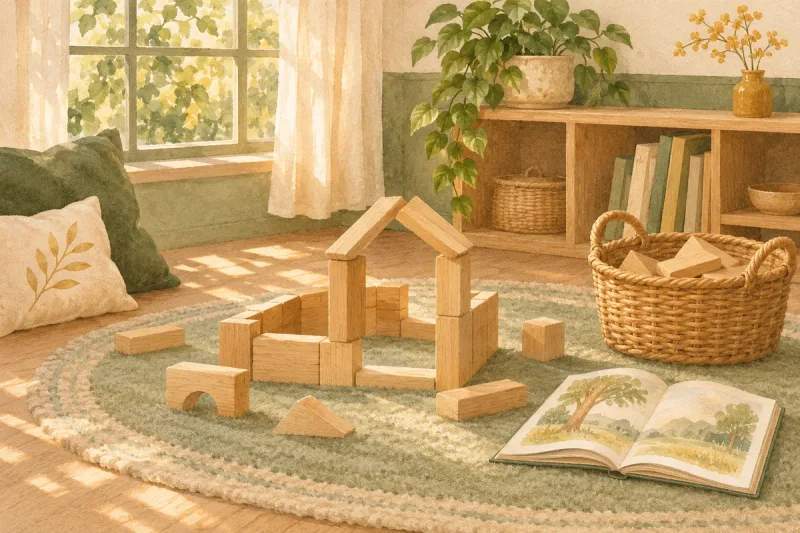
Part of the difficulty is that these experiences ask different things of your child. A fast-paced video keeps introducing something new to watch. Many games supply the next goal, prompt, or reward. In contrast, building with blocks requires your child to decide what to make, work out how to make it, and stay interested as the idea develops. Your child has a larger role in creating and sustaining the activity.
Watching for a long time does not necessarily mean your child can concentrate just as long in every setting. Make quieter activities easier to enter and give your child time to become absorbed.
How can I help my child stay with an activity?
Use an interest your child already has and join them briefly to help the activity get going. If your child likes vehicles, they might build a road. If they enjoy stories, they might draw a character and decide what happens next. Then leave room for your child to develop the idea and continue.
How can I protect my child’s attention during play?
Your role is to support your child’s ideas without taking over. If a bridge keeps falling, you might ask, “What could hold up this end?” Then your child needs time to try something. A small amount of help can keep a difficult moment from ending the activity. Once your child has a next step, give them room to continue.
Reduce competing input.Turn off background television and put devices away.
Allow time to think.Give your child a chance to try an idea before offering another suggestion.
Let an activity continue.When your child becomes absorbed, avoid interrupting to introduce something new.
What parents say
I like watching my son have to listen to the question and respond. It's so much different than other apps.
My son loved the develop-a-story game. The more the student can contribute, the better.
My daughter loves that it's challenging and "real," and she loves talking to the Sage teacher.
Your next step
Make screen time another place to create and learn
Alongside offline play, Sage Teacher offers creative exploration and reading and math lessons with a personal AI teacher. There are no points, prizes, or streaks, and you choose how long the session lasts.
Start my free trial with Sage TeacherFrequently asked questions
Why might a child watch a video for a long time but leave a toy quickly?
Fast-paced media can keep introducing the next prompt or reward. Blocks, books, and imaginative play ask the child to decide what to do and stay with an idea as it develops.
How can I help my child stay interested in screen-free play?
Start with a familiar interest, help your child enter the activity, then give them room to continue. When a difficulty appears, a small question or next step can help without taking over.
Can background television interrupt play?
Yes. The article describes research in which background television interrupted young children's sustained play, even when they only glanced at it. Read the cited study.